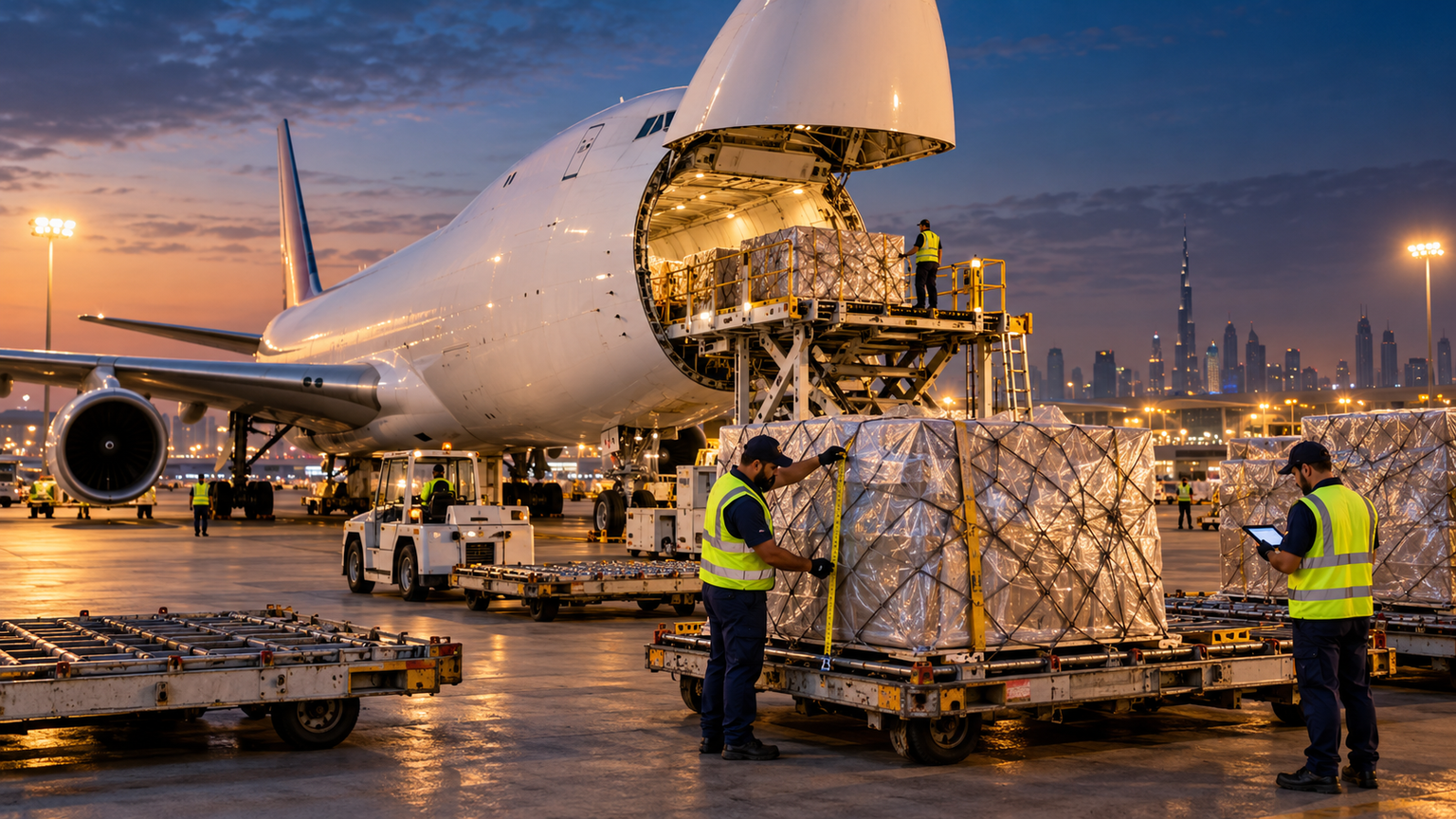
Air freight from Dubai moves through two major cargo gateways, Dubai International (DXB) and Al Maktoum International at Dubai World Central (DWC), with scheduled passenger belly capacity and dedicated freighter services to Asia, Africa, Europe and the Americas. Speed is the reason most shippers choose air, but a fast flight only helps when the booking, packing, documents and destination handover are ready on time. NHK Logistics' air freight service in Dubai plans these steps together, from airport-to-airport uplift to door delivery.
Confirm that air freight fits the shipment
Air freight suits cargo whose delay costs more than the premium for speed: replacement parts holding up production, samples needed for a buying decision, launch stock, pharmaceuticals and higher-value goods. Bulky, dense or non-urgent cargo often belongs on a vessel instead. If you have not settled the mode, our air freight versus sea freight guide walks through the trade-offs, and the door-to-door forwarding guide explains how a forwarder joins the legs around either choice.
Also check the physical limits. Lower-deck capacity on passenger aircraft accepts standard pallets and loose cartons, while tall or long pieces, heavy single units and some vehicle or machinery parts need a freighter with a main-deck door. Share the dimensions of the largest piece and the weight of the heaviest piece early so the team can confirm aircraft type and routing before you commit.
Prepare a complete booking request
An airline booking is made against specific pieces, weights and dimensions, so the request should describe the shipment as it will be handed over, not as it sits on a product list. Send the following in one message so the quote and the booking use the same figures.
- Origin pickup address, or the airport where you will deliver the cargo
- Destination airport or final delivery address, with the consignee's contact details
- Number of pieces, packaging type and whether the cargo is palletised or loose
- Length, width and height of each piece type, and the gross weight per piece
- Plain-language commodity description and the HS code where known
- Cargo-ready date, requested delivery date and whether that date is fixed
- Service level: priority uplift on the next available flight or a standard consolidation
- Special handling: temperature control, dangerous goods, batteries, perishables, valuables or fragile items
Our freight quote checklist gives a reusable format for this. Measure after final packing, including the pallet, and mark estimates as estimates so that nobody books space against figures that will change.
Understand chargeable weight
Air cargo is priced on chargeable weight, which is the greater of the actual gross weight and the volumetric weight. Volumetric weight reflects the space the cargo occupies on the aircraft. The widely used calculation is length x width x height in centimetres divided by 6,000, which gives the volumetric weight in kilograms per piece; some carriers and forwarders apply a different divisor, so confirm which one your quotation uses.
Example: ten cartons of foam components each measure 60 x 50 x 40 cm and weigh 12 kg. Volumetric weight per carton is 60 x 50 x 40 / 6,000 = 20 kg, so the shipment's chargeable weight is 10 x 20 = 200 kg rather than the 120 kg on the scale. The same ten cartons filled with steel fittings at 25 kg each would be charged on the 250 kg gross weight instead. This is a worked calculation, not a rate, but it shows why packing density changes the cost of an air shipment.
Reducing void space inside cartons, choosing a tighter carton size or shipping parts unassembled can lower the chargeable weight. Ask the team to review the packing before booking if the volumetric figure is far above the gross weight.
Pack and label for air handling
Air cargo is loaded quickly, moved by forklift and dolly, built onto unit load devices and sometimes transferred between aircraft at a hub. Use new double-wall cartons, fill voids, strap or stretch-wrap pallets, protect edges and keep the load within the pallet footprint. Each piece should carry the shipper and consignee names, the destination, the piece number out of the total and any handling marks such as 'this way up' or 'fragile'.
Palletised cargo is easier to accept, count and secure than loose cartons, and it reduces damage. If cargo needs consolidation, re-palletising or a pre-shipment check before it goes to the airport, plan that through our warehousing and cross-stuffing service rather than at the airline's acceptance counter.
Declare dangerous goods, batteries and restricted items
Air transport applies the IATA Dangerous Goods Regulations, which cover far more than obvious chemicals: lithium batteries in equipment or shipped on their own, aerosols, perfumes, paints, magnets, some laboratory samples and many power tools. Undeclared dangerous goods are the most common reason an air shipment is refused at acceptance, and they can expose the shipper to penalties.
Tell the forwarder what the goods contain before booking. Dangerous goods need correct classification, UN-specification packaging where required, marks, labels and a shipper's declaration, and not every airline accepts every class on every route. Perishable and temperature-sensitive cargo needs its own handling plan: packaging, maximum time out of refrigeration and cool-chain handling at both airports. Share those requirements with the air freight team when you request the quote.
Meet airport cutoffs and security screening
Every booking has a cargo acceptance deadline at the airline's ground handler and a separate cutoff for documents. These fall hours before departure and can be earlier for consolidations and for cargo that still needs screening. Treat the acceptance time, not the flight time, as the operational deadline, and build in time for the truck to reach the cargo terminal, queue and tender the shipment.
Export cargo is security screened before it is loaded. Cargo from an approved known-consignor or regulated-agent supply chain may already be secured; other cargo is screened at the airport, which can take longer for dense pallets, mixed consolidations and some commodities. Early delivery to the terminal gives the screening and build-up process room to work without missing the flight.
The air waybill: what it is and what to check
The air waybill (AWB) is the airline's contract of carriage and its receipt for the goods. Unlike a negotiable bill of lading, it is not a document of title, so the cargo is released to the named consignee at destination rather than to whoever holds an original. Most airlines now issue electronic air waybills, with the data transmitted to the carrier and customs instead of paper copies travelling with the cargo.
For a consolidated shipment, the forwarder issues a house air waybill to you and the airline issues a master air waybill to the forwarder covering the whole consolidation. Before the draft is finalised, check the shipper, consignee and notify details, piece count, gross weight, dimensions, nature of goods, declared value for carriage and for customs, handling information and the airport codes. The AWB number is the reference you will use to track the shipment and the one destination customs will match against the invoice.
Clear export customs before uplift
Export cargo leaving Dubai needs an export declaration with Dubai Customs, supported by the commercial invoice and packing list and, for controlled goods, the relevant permit. The declaration should be released before the cargo is tendered to the airline. Goods moving from a free zone or under a temporary-admission or re-export arrangement follow their own procedures, so state the cargo's customs status when you book.
NHK Logistics files the export declaration through its customs clearance service, and our Dubai customs documents guide lists what to prepare. Keep the description, quantities, weights and values consistent across the invoice, packing list, air waybill and declaration; a mismatch is the usual trigger for a hold on either side of the flight.
Plan the destination handover
A fast flight is wasted if the cargo then sits at the destination terminal. Airport free storage is typically measured in days, not weeks, so the consignee or their broker should receive the air waybill, invoice and packing list before arrival and prepare the import declaration. Agree in advance who pays destination charges, duties and taxes, which the trade term on the purchase order decides; our Incoterms guide explains the common terms.
For door delivery, NHK Logistics arranges destination clearance and the final truck leg through its partner agents. On regular lanes such as Dubai to Pakistan, urgent parts and samples are usually quoted by air alongside a sea freight option for the balance of the order. Within the UAE, airport collection and onward delivery are handled by our land transport team.
Track the milestones that matter
- Booking confirmed with flight details and the acceptance deadline
- Cargo collected and measured, final figures matched to the booking
- Export declaration released
- Accepted at the airport terminal and screened
- Departed, with any transit connection confirmed
- Arrived at destination and arrival notice sent
- Import clearance completed and cargo collected
- Proof of delivery received
Updates should name the latest confirmed event and the next action with its owner. Flights can be delayed, connections missed or cargo offloaded for capacity reasons, so the plan should show how a missed uplift is recovered rather than promising a fixed delivery time before the cargo has flown.
Request an air freight quote from Dubai
To plan an air shipment, send your details to NHK Logistics: pickup and delivery points, pieces with dimensions and weights, commodity, cargo-ready date, required delivery date and any special handling. The team will confirm the routing, aircraft suitability, chargeable weight and the documents needed before uplift, or compare the air option with sea freight through our freight forwarding service if the deadline allows.
Need help with a shipment?
Send us the route and cargo details. We reply within 2 business hours.
Request a Quote