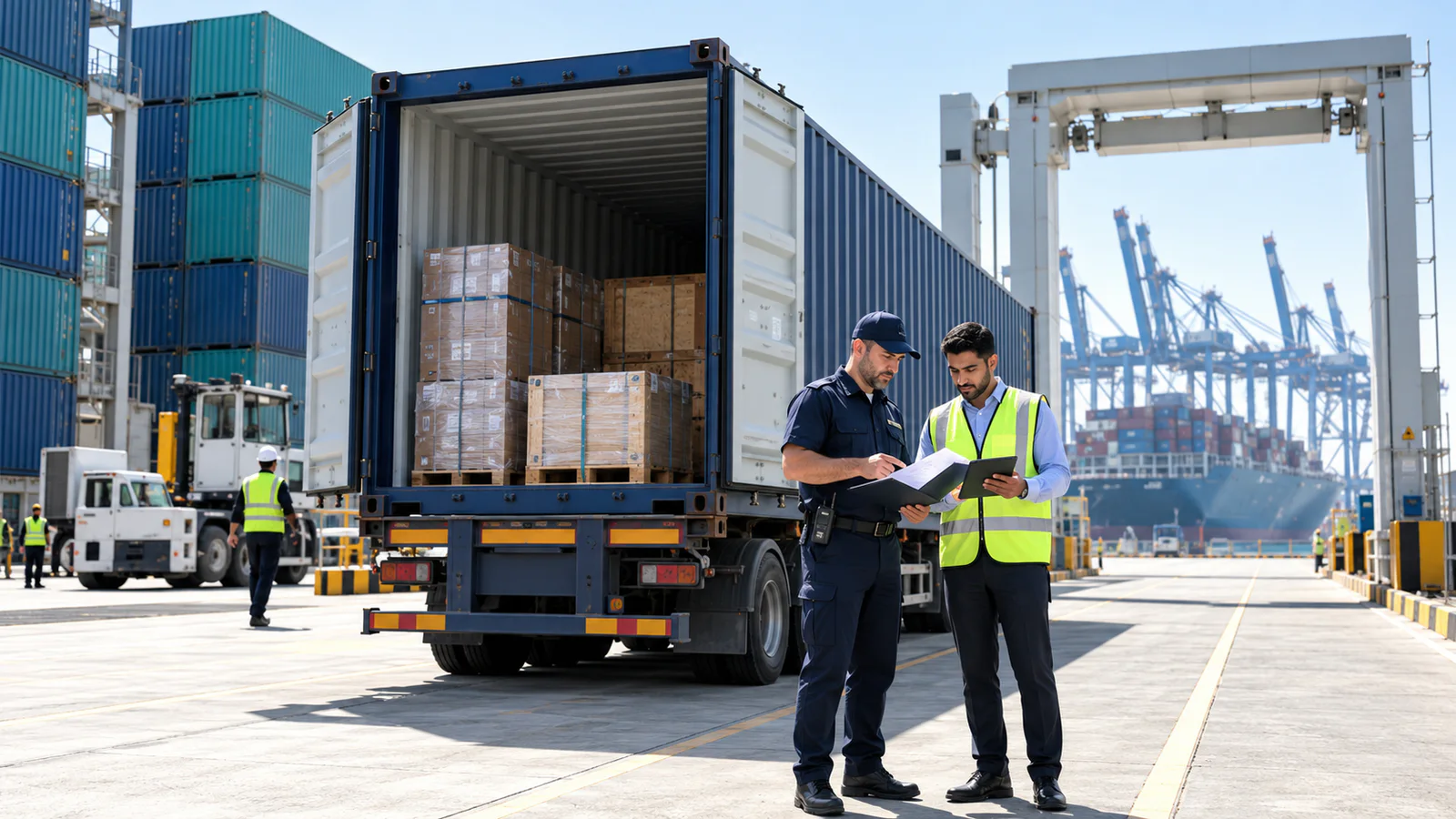
Every container that arrives at Jebel Ali is released twice: once by Dubai Customs, which checks the declaration, the duty and the permits, and once by the shipping line and the terminal, which hand the box to a truck. The customs release is the step importers control least and worry about most, because a classification error, an unregistered importer code or a missing permit stops a shipment that is otherwise ready to leave. NHK Logistics' Jebel Ali customs clearance service prepares the file before the vessel berths so that both releases happen in the same window. This guide explains each stage of an import clearance and what the importer needs to have ready.
Register with Dubai Customs before the vessel sails
A declaration is filed under an importer code issued by Dubai Customs against a valid UAE trade licence, with the goods you import matching the licensed activity. New importers should register the code before the cargo is shipped, not when the arrival notice lands, because registration and any licence corrections take working days. VAT-registered businesses should also link their tax registration number to the customs code so that import VAT is recorded against the right entity.
Free-zone companies in Jebel Ali Free Zone clear under their own free-zone status, and goods moving from the zone into the UAE mainland are treated as an import at that point. A mainland buyer who purchases from a free-zone seller therefore needs its own importer code even though the goods never leave Dubai. If you are still deciding how the supply chain should be structured, our freight forwarding service can map which company imports, where duty is paid and where the goods are stored. For companies without a UAE entity, our door-to-door forwarding guide explains how a forwarder or a local consignee takes that role.
Classify the goods with the correct HS code
Customs duty, import restrictions, permit requirements and statistical reporting all follow from the Harmonised System code declared for each line. The UAE applies the GCC unified tariff, so the first six digits are internationally recognised and the remaining digits are set regionally. A code that is close but not correct can mean a different duty rate, a permit demand that does not apply to your product or a post-clearance query months later.
Classify by what the product is and what it is made of, not by its trade name. Composite goods, kits, parts and accessories, and items that can be classed as either machinery or a consumer product are the usual trouble spots. Ask NHK Logistics' customs clearance team for a pre-check of the codes while the supplier is still preparing the invoice; agreeing the classification before the goods ship is far cheaper than amending a declaration after the container has arrived. Keep the same code, description and unit of quantity on the invoice, packing list and declaration, following the document rules in our Dubai customs documents guide.
Value the shipment for duty and VAT
Customs duty in the UAE is generally calculated on the CIF value, meaning the value of the goods plus the freight and insurance to the UAE port. Most goods attract the standard GCC rate of 5 percent of that value; some categories are exempt, and a small number of products such as tobacco and alcohol carry much higher rates. Value-added tax is charged on imports as well, assessed on the CIF value plus the duty. Importers registered for VAT with their tax number linked to their customs code normally account for the import VAT through their tax return rather than paying it at the port, while unregistered importers pay it before release.
This is why the sale terms matter at the border. An invoice issued on FOB terms shows the goods value only, so the freight and insurance must be added for the customs value, whereas a CIF invoice already includes them. Our Incoterms guide explains which costs sit inside each term. Make sure the invoice states the terms, the currency and any discounts clearly, and that the freight shown matches the carrier's bill. Related-party pricing, free-of-charge samples, repaired goods and warranty replacements have their own valuation rules and should be flagged to the broker in advance.
Choose the declaration type that matches the movement
Dubai Customs uses different declaration types for different customs regimes, and the type decides what duty is collected and what the importer can do with the goods afterwards. Filing the wrong type is a common cause of a container being held for amendment. The main regimes an importer at Jebel Ali meets are:
- Import for local consumption: duty and VAT are paid and the goods move freely in the UAE
- Import into a free zone: goods enter Jebel Ali Free Zone or another zone under suspension of duty, which becomes payable if they later move to the mainland
- Free zone to mainland transfer: the mainland buyer files an import declaration before the goods leave the zone gate
- Transit: goods cross the UAE under customs control to another country, for example by road to Saudi Arabia, with a guarantee and an exit confirmation
- Temporary admission: equipment, exhibition goods and project machinery enter for a set period against a deposit or guarantee and must be re-exported
- Re-export: goods imported and then shipped out again, where duty paid earlier may be refundable within the period and under the conditions Dubai Customs sets
Temporary admission is the usual regime for the machinery and site equipment handled by our project cargo service. Transit cargo bound for Saudi Arabia follows the border process described in our Dubai to Saudi road freight guide and the Dubai to Saudi Arabia shipping page. Goods held for later distribution often enter a free-zone or bonded facility first, which our warehousing and cross-stuffing service arranges; the Jebel Ali warehousing guide explains when that is the better route.
Assemble the file: documents, release and permits
A standard import file at Jebel Ali contains the bill of lading, the commercial invoice, the packing list and a certificate of origin, together with the delivery order from the shipping line or its agent. For a consolidated shipment, the forwarder's house bill of lading is released by the consolidator, so ask who issues the delivery order; our NVOCC guide describes the house and master bill structure and how release works through our NVOCC services.
Controlled goods need an approval from the responsible authority before customs will release them, and the permit must be obtained by the importer, not the broker. Foodstuffs, cosmetics, medicines and medical devices, telecommunications equipment, electrical products subject to conformity marking, chemicals, and imported vehicles each have their own registering body and lead time. Confirm which approvals apply when you fix the HS code, and start the application before the goods ship. A certificate of origin also matters for duty: goods of GCC origin and goods covered by a trade agreement can qualify for reduced or zero duty when the origin document is in the correct form.
What happens after filing: risk channels and inspection
Once the declaration is submitted, the customs system assesses it against risk criteria and either releases it on the documents, calls for additional documents, selects the container for scanning or orders a physical examination. Scanning takes place within the terminal and usually adds a short delay. A physical examination means the container is moved to an inspection area and opened, with the goods counted against the packing list, which takes longer and can involve handling charges, particularly if the cargo needs to be unstuffed and restuffed.
Inspection rates rise when the declared description is vague, when the value looks low for the commodity, when the shipper or importer is new, or when the goods belong to a controlled category. The practical defences are a precise description, consistent figures across every document, a packing list that matches the load plan, and permits attached to the file at submission. If a container is examined, the broker should attend or be reachable so that any query is answered the same day rather than after a weekend.
Release, port charges and collection
A customs release is only the first of three clearances the truck needs. The shipping line, or the shipping agent acting for it, issues its delivery order once the original bill of lading has been surrendered or a telex release received and the line's charges are settled. The terminal then needs its handling and storage charges paid and a gate appointment booked before the container can be collected. These steps run in parallel when the file is complete; they run in sequence, and eat free time, when it is not.
Free time on the container has two clocks: port storage at the terminal and the line's detention on the equipment, explained in our sea freight free-time guide. NHK Logistics' land transport service collects released containers from Jebel Ali and delivers across the UAE; our UAE container trucking guide explains how the port move, the delivery site and the empty return are organised so that detention is not the cost that spoils an otherwise clean clearance.
Example: one container, two product types, one weekend
A Dubai mainland distributor imports a 40-foot container carrying kitchen appliances and a small line of cosmetics from the same supplier. The documents arrive four days before the vessel. A pre-check finds that the appliances need a conformity approval the importer already holds, but the cosmetics line has not been registered with the municipal product registration scheme and the invoice shows a single lump value for both product groups.
Two actions follow. The supplier reissues the invoice with separate lines, values and HS codes, and the cosmetics are declared into a bonded warehouse under duty suspension while the registration is completed, with the appliances declared for local consumption and delivered to the distributor the day after discharge. Without the pre-check, the whole container would have waited for the cosmetics approval, with port storage and detention accruing over a weekend. The split used the FCL and LCL thinking in reverse: one container, two customs outcomes.
Common reasons an import is held at Jebel Ali
- Importer code not registered, suspended or not matching the consignee on the bill of lading
- HS code or description inconsistent between the invoice, the packing list and the declaration
- Permit for a controlled product not obtained, or obtained by the wrong entity
- Invoice value or currency unclear, or freight and insurance missing from the customs value
- Wrong declaration type for the intended movement, for example local consumption instead of free zone
- Original bill of lading not surrendered, so the line will not issue the delivery order
- Certificate of origin missing or in a form that does not support the duty claim
- Container selected for examination and nobody available to answer the customs query
Exports and re-exports through Jebel Ali
Outbound cargo follows the mirror process: an export declaration with the invoice, packing list and any export permit, released before the container is gated in against the vessel cutoff. Goods leaving on regular lanes, such as containers to Karachi on our Dubai to Pakistan lane described in the Dubai to Pakistan shipping guide, and vehicles exported under our car shipping service each have their own document set. Urgent exports by air use the airport declaration flow described in our air freight from Dubai guide and filed through our air freight service. Heavy project pieces that are inspected on open equipment are covered in the project cargo guide.
Request Jebel Ali customs clearance
To have a shipment pre-checked, send NHK Logistics the draft documents as soon as the supplier issues them: invoice, packing list, bill of lading or booking confirmation, product descriptions and your importer code. The team will confirm the HS codes, the duty and VAT treatment, the declaration type, the permits required and the collection plan, and will coordinate the port move through our sea freight and land transport teams so that the customs release and the physical release happen together.
Need help with a shipment?
Send us the route and cargo details. We reply within 2 business hours.
Request a Quote