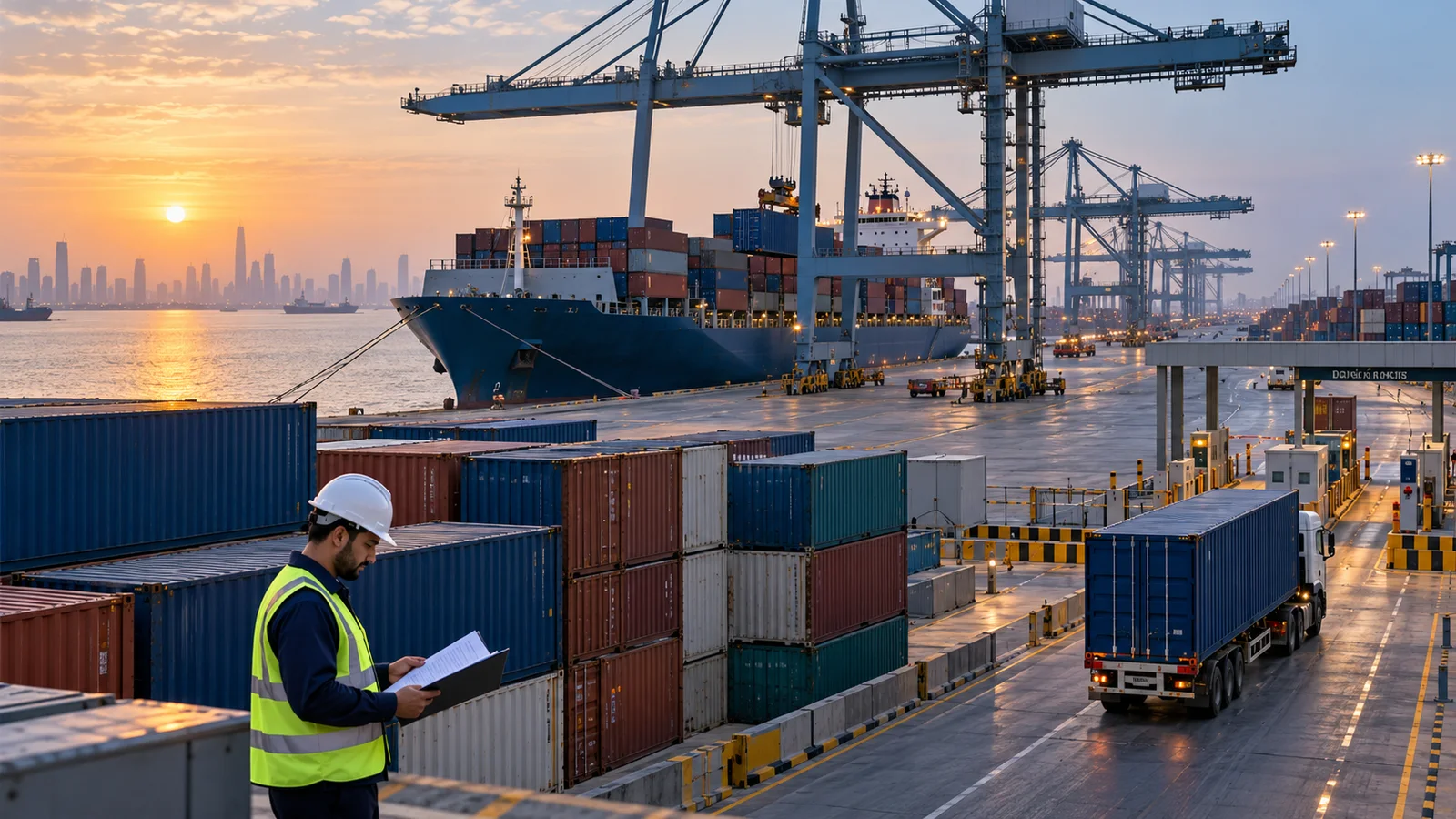
Most cargo from the UAE to Saudi Arabia goes by road, but sea freight is the better answer more often than shippers expect: heavy and bulky loads, full containers that are already packed for export, cargo for the Red Sea coast, dangerous goods that road carriers restrict, and consignments where a lower rate matters more than a shorter transit. NHK Logistics books containers from Jebel Ali to Dammam and Jeddah through its Dubai-to-Saudi shipping service and compares the sea option with trucking on every quotation. This guide explains when the sea route wins, how to choose the port and what the Saudi side needs.
Sea or road: compare on the whole shipment
Road freight is usually the faster door-to-door choice for general cargo, as our Dubai-to-Saudi road freight guide explains. Sea freight competes when the cargo already sits in a container, when weight or dimensions exceed what a truck can carry economically, when the delivery point is near Dammam or Jeddah, or when the schedule allows a few extra days in exchange for a lower rate. Compare the two on the total chain, including UAE collection, export clearance, the main leg, Saudi clearance and final delivery, rather than on the freight rate alone.
- Sea tends to suit: full containers, heavy machinery, bulk raw materials, Red Sea coast deliveries, DG classes that road carriers limit
- Road tends to suit: time-critical part loads, pallets for Riyadh and the Eastern Province, cargo that must be delivered on a fixed appointment
- Either can suit: regular replenishment shipments, where a mix of road and sea keeps cost and stock levels balanced
Dammam or Jeddah: pick the port around the delivery city
Dammam's King Abdulaziz Port sits on the Gulf coast close to Jebel Ali and serves the Eastern Province and, by road, Riyadh and the centre of the country. Jeddah Islamic Port on the Red Sea serves the western region, Makkah, Madinah and the industrial cities around it, and is reached by a longer voyage around the Arabian Peninsula. Choose the port by the consignee's city and the inland distance, then check which carrier offers a direct service or a transhipment for that port, because a direct feeder to Dammam and a transhipped service to Jeddah behave very differently in schedule and cost.
FCL, LCL or a container stuffed in Dubai
Full-container shipments give the simplest handling: the container is packed and sealed in the UAE, moves under one bill of lading and is delivered intact to the consignee. Our FCL booking guide covers the booking, cut-offs and verified gross mass. Smaller consignments can move as LCL through a consolidation to Dammam or Jeddah, described in our LCL consolidation guide, or several suppliers' goods can be received at our Jebel Ali facility and cross-stuffed into one container before departure. When the cargo is borderline, the FCL versus LCL comparison helps settle it.
Saudi import documents and product conformity
Saudi customs clearance is handled through the FASAH single-window platform by the consignee's licensed broker, under the Zakat, Tax and Customs Authority. The standard documents are the commercial invoice, packing list, bill of lading and certificate of origin, and the consignee's importer registration must be active before the vessel arrives. Many product categories also need a certificate of conformity issued through the SABER platform against the applicable Saudi technical regulations, and that certificate is obtained before shipment, not at the port. Confirm with the consignee which products are regulated, because a container that arrives without the required SABER certificate waits at the port while it is arranged.
- Commercial invoice with HS codes, values, origin and the consignee's registration details
- Packing list matching the invoice line by line with weights and dimensions
- Bill of lading issued to the correct consignee and notify party
- Certificate of origin from the chamber of commerce for origin-based duty treatment
- SABER product and shipment certificates for regulated goods
- Any permits for food, pharmaceuticals, chemicals or telecom equipment
Duty treatment depends on origin
Goods manufactured in the UAE or another GCC state with a valid GCC certificate of origin are treated differently from foreign goods re-exported from Dubai, and foreign goods that were imported into the UAE under duty-paid status are treated differently again from goods that moved through a free zone. The consignee's broker applies the correct treatment at clearance, but the documents issued in Dubai have to support it: the certificate of origin, the invoice and the free-zone or mainland export declaration must tell the same story. NHK Logistics prepares the UAE side through its customs clearance service and flags origin questions before the booking is confirmed.
Export clearance and loading at Jebel Ali
The UAE export declaration is filed before the container enters the port, and the container must reach the terminal within the carrier's cut-offs with the verified gross mass declared. Our sea freight container guide explains container selection, cut-offs, free time and the bill of lading, and our container trucking guide covers the UAE collection and port move. For dangerous goods the Saudi port and the carrier both have acceptance rules, which the dangerous goods shipping guide describes.
Arrival, release and delivery inside Saudi Arabia
After the vessel arrives, the consignee's broker files the FASAH declaration, any inspection is completed and the container is released against the bill of lading and port charges. From Dammam the container is trucked to Riyadh, Al Khobar, Jubail or other Eastern Province cities; from Jeddah it serves the western region. NHK Logistics coordinates the onward move with its Saudi transport partners through its land transport service, including the empty container return within the carrier's free time so that detention does not erase the saving that made sea the right choice.
Example: machinery for a plant near Dammam
A UAE manufacturer sends two 40ft containers of packaged machinery to a plant in Jubail. Road freight would need low-loader capacity and permits for the heavier crates, so the containers are stuffed and sealed at the factory, trucked to Jebel Ali, shipped to Dammam on a direct feeder and trucked to the plant on standard chassis. The SABER certificates are obtained before loading, the certificate of origin supports GCC-origin treatment, and the consignee's broker clears both containers on one declaration. The sea option costs less than the road option for this cargo and arrives inside the plant's installation window.
What to send for a Dubai-to-Saudi sea freight quote
- Pickup location in the UAE and whether the cargo is already containerised
- Delivery city in Saudi Arabia and the consignee's broker contact
- Cargo description, HS codes, weight, dimensions or container count
- Whether SABER certificates or other permits are already in hand
- Ready date and any required delivery window
- Incoterms agreed with the buyer, explained in our Incoterms guide
Book sea freight to Saudi Arabia with NHK Logistics
NHK Logistics in Business Bay arranges the UAE collection, export clearance, the container booking from Jebel Ali through its sea freight and NVOCC services, and the onward delivery in Saudi Arabia through its freight forwarding service. Send the shipment details through the Dubai-to-Saudi shipping page or the contact form and the team compares sea and road for your cargo in one written quotation.
Need help with a shipment?
Send us the route and cargo details. We reply within 2 business hours.
Request a Quote