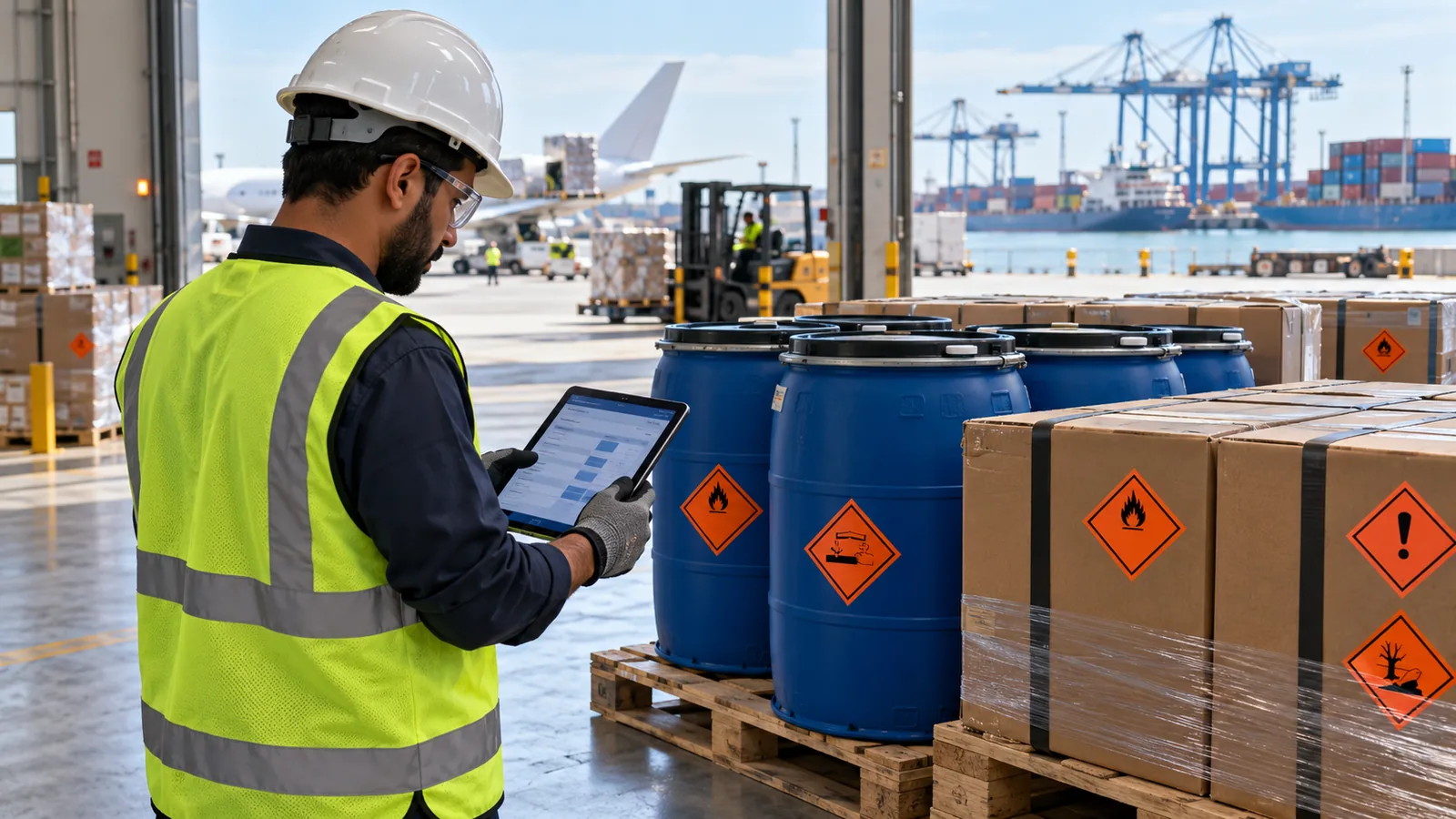
Paints, chemicals, perfumes, aerosols, cleaning products, generators, spare parts with oil in them and anything with a lithium battery can all count as dangerous goods (DG). They can still be shipped from Dubai, but airlines and shipping lines accept them only when the cargo is correctly classified, packed, labelled and declared. A missing detail usually means the booking is refused at the airport or the terminal and the cargo waits. This guide explains how NHK Logistics prepares DG shipments through its air freight and sea freight services, and what you need to provide.
Is your cargo dangerous goods?
Do not guess from the product name. The answer is in the safety data sheet (SDS, often called MSDS) from the manufacturer. Section 14 of the SDS, Transport Information, shows whether the product is regulated and gives its UN number, proper shipping name, hazard class and packing group. If section 14 says "not regulated" for air (IATA) and sea (IMDG), the goods normally ship as general cargo, but carriers still often ask to see the SDS.
- Class 1 explosives, including some fireworks and ammunition (very restricted)
- Class 2 gases: aerosols, gas cylinders, fire extinguishers, refrigerant
- Class 3 flammable liquids: paints, perfumes, solvents, some inks and adhesives
- Class 4 flammable solids
- Class 5 oxidisers and organic peroxides
- Class 6 toxic and infectious substances
- Class 7 radioactive material
- Class 8 corrosives: acids, batteries with acid, some cleaning chemicals
- Class 9 miscellaneous: lithium batteries, dry ice, magnetised material, some engines and vehicles
Send the SDS with your first enquiry. It is the single document that decides how the cargo can move, and our freight quote checklist lists the other details a forwarder needs.
Air or sea for DG cargo
Air freight follows the IATA Dangerous Goods Regulations, and many items are limited to cargo aircraft only or to small quantities per package. Some airlines do not accept certain classes at all. Sea freight follows the IMDG Code and generally accepts larger quantities, but each line has its own DG acceptance process, extra charges and sometimes fewer vessel options. As a rule, small urgent DG consignments go by air; drums, IBCs and bulk chemicals go by sea. Our air vs sea guide covers the general trade-off, and the air freight booking guide explains how chargeable weight is calculated.
Packaging, marks and labels
Most DG must travel in UN-specification packaging: boxes, drums or jerrycans tested and marked for the class and packing group. Inner containers must be closed tightly and cushioned, and liquids need enough absorbent material and space to expand. Each package then needs the correct marks and labels.
- UN number and proper shipping name on the package
- Hazard class label (diamond) and any secondary hazard label
- Orientation arrows for liquids
- "Cargo Aircraft Only" label where the air rules require it
- Shipper and consignee name and address
- Limited-quantity or excepted-quantity mark where the cargo qualifies
If your supplier's packing is not suitable, the cargo can be repacked into UN packaging at a warehouse. Our warehousing and cross-stuffing team can receive, check and prepare goods before they go to the airport or port.
The dangerous goods declaration
For air cargo the shipper signs a Shipper's Declaration for Dangerous Goods, and for sea cargo a DG declaration under the IMDG Code. It lists the UN number, shipping name, class, packing group, number and type of packages, net quantity and an emergency contact. The declaration must match the labels and the SDS exactly, and it must be prepared by someone trained in DG rules. Your forwarder can prepare it for your signature, but the shipper remains responsible for what is declared.
Lithium batteries: the most common problem
Electronics, power tools, scooters, phones, laptops and solar storage all contain lithium batteries, and they are one of the most frequent reasons for DG holds. Air rules separate batteries shipped on their own, batteries packed with equipment and batteries contained in equipment, and lithium-ion from lithium-metal. Each has its own UN number, state-of-charge limits for some shipments and label requirements.
- Ask the manufacturer for the UN 38.3 test summary for the battery
- Note the watt-hour rating (lithium-ion) or lithium content (lithium-metal)
- Say whether batteries are loose, packed with or installed in the equipment
- Expect damaged, defective or recalled batteries to be refused by air
- Large batteries and battery-powered vehicles usually move by sea as class 9
Booking DG through Jebel Ali and DXB
DG bookings need carrier approval before the cargo is delivered. For sea freight, the line checks the declaration and confirms which vessel and stowage can take it; some classes must be delivered directly to the vessel rather than stored at the terminal. For air, the airline or handling agent checks the packages before acceptance. Build extra days into the plan, especially near sea freight cutoffs. Trucks carrying DG to the port or airport also need suitable vehicles and drivers, which our land transport team arranges.
Some products, such as certain chemicals, pesticides and controlled substances, also need a permit from the relevant UAE authority before export or import. The customs clearance team checks this alongside the export declaration, and our Dubai customs documents guide lists the core papers. For DG arriving into the UAE, see the Jebel Ali import clearance guide.
Common reasons DG cargo is rejected
- SDS older than the product formula, or missing section 14
- Package marks that do not match the declaration
- Non-UN packaging for goods that require it
- Leaking or damaged packages
- Lithium battery details missing or no UN 38.3 summary
- Cargo delivered before the carrier approved the DG booking
- Mixed DG classes packed together that must be kept apart
Dangerous goods shipping checklist
- Current SDS with section 14 transport information
- UN number, class and packing group confirmed for air or sea
- UN-specification packaging and correct marks and labels
- Signed dangerous goods declaration from a trained person
- Lithium battery type, rating and UN 38.3 summary where relevant
- Permits for controlled products
- Carrier DG approval before delivery to port or airport
- Commercial invoice and packing list matching the declaration
Ship your DG cargo with NHK Logistics
Send us your SDS and packing details with the destination and ready date. The team will confirm whether the goods can move by air or sea, arrange packaging and labels if needed, and coordinate the booking with freight forwarding and customs through to delivery.
Need help with a shipment?
Send us the route and cargo details. We reply within 2 business hours.
Request a Quote