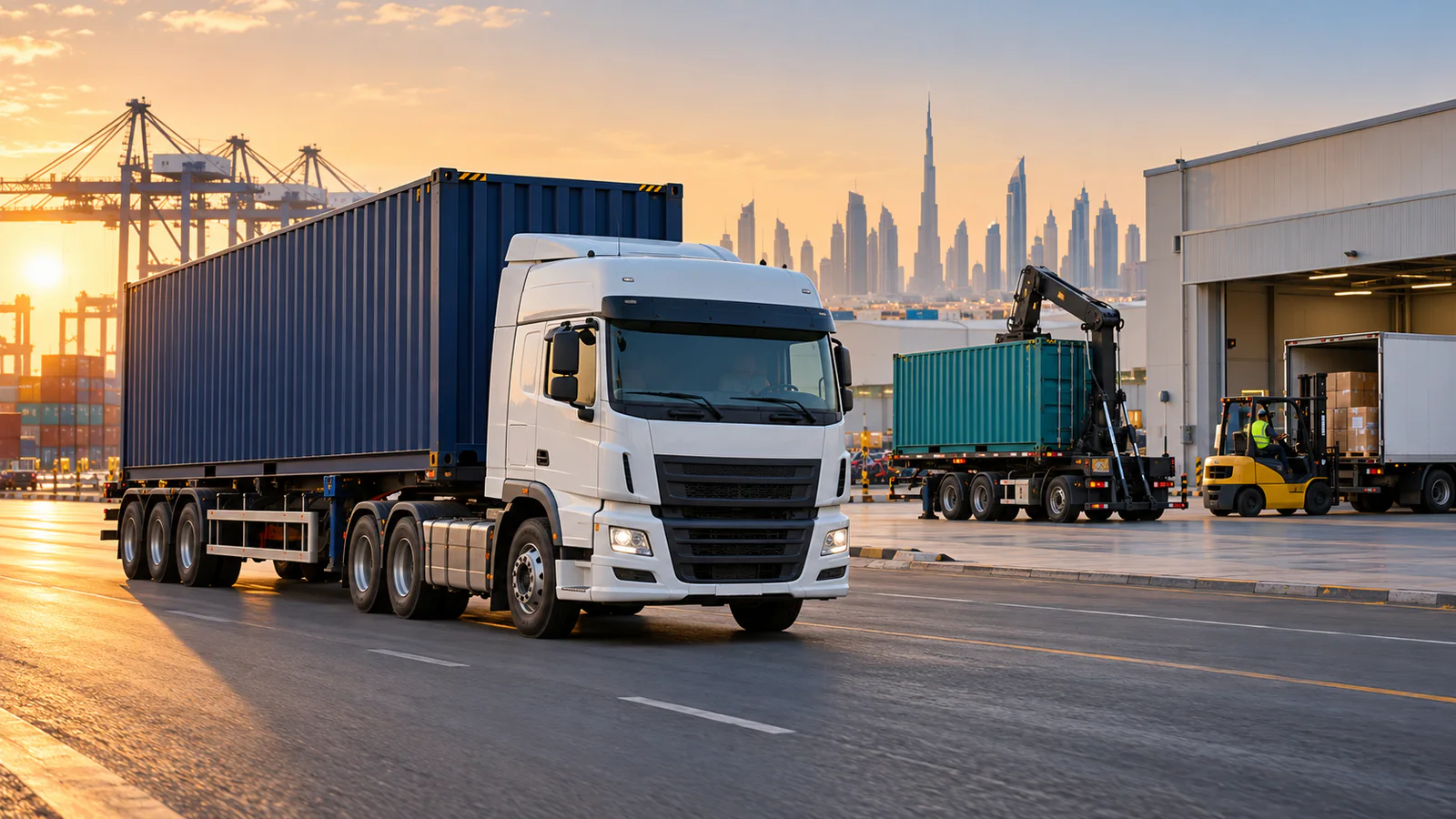
A container released at Jebel Ali still has to reach a warehouse in Al Quoz, a factory in Mussafah or a site in Fujairah, and the empty box has to come back to the shipping line's depot. That local leg is short in kilometres but full of detail: the right trailer, a port gate appointment, truck weight rules, peak-hour restrictions, a delivery site that may have no loading dock and a detention clock running from the day the container left the terminal. NHK Logistics' land transport service plans the haulage alongside the sea freight and customs steps so that a released container does not sit at the port waiting for a truck.
Match the vehicle to the cargo and the delivery site
The cheapest truck is the one that can actually unload at the destination. Before quoting, the dispatcher needs to know whether the container will be unloaded on the chassis at a dock, dropped on the ground for unloading over several days, or opened at a warehouse that will unstuff it and send the goods on in smaller vehicles. The common options in the UAE are:
- Skeletal container trailer: the standard port move for 20-foot and 40-foot containers unloaded at a dock-height bay
- Side-loader or self-loading trailer: places the container on the ground at a site without a dock or crane and collects it later
- Flatbed and low-side trailers: crated, palletised or strapped cargo loaded and unloaded by forklift or crane
- Curtain-side trailers: pallets and cartons that need weather protection and side access
- Box trucks, roughly three to ten tonnes: local distribution, part loads and deliveries into restricted urban streets
- Lowbed and extendable trailers: machinery, out-of-gauge and project pieces that exceed normal height, width or axle weight
- Refrigerated trucks: temperature-controlled loads moving from a reefer container or cold store to the consignee
- Vehicle carriers: cars and light vehicles moving between port, showroom and yard
Out-of-gauge and heavy pieces need a route survey, escort and permit plan, which our project cargo guide and project cargo service cover. Vehicles follow the yard-to-port and port-to-showroom process on our cars transportation page and in the RoRo versus container guide.
Book the port move: release, charges and gate appointment
A truck can only collect a container once three releases line up: the customs release, the shipping line's delivery order and the terminal's own release after its charges are paid. The customs part is explained in our Jebel Ali import clearance guide and handled by our customs clearance team. The terminal then issues a gate appointment for a specific truck, driver and time window, so the haulier needs the container number, the delivery order details and the consignee's instructions before the slot is booked. For consolidated cargo released through a house bill of lading, the release flow in our NVOCC guide applies first.
Missed appointments cost a day, not an hour, because the next slot and the next available truck rarely coincide. Share the release status with the dispatcher as each step completes rather than sending a single 'all clear' at the end, so the truck is positioned when the last release lands. Exports work in reverse: the empty is collected from the line's depot, loaded at the shipper, weighed for the verified gross mass and gated in against the cutoffs in our sea freight from Dubai guide.
Weight limits, permits and road timing
Road weight rules are separate from the container's rating. A 20-foot box loaded to its maximum payload can exceed the permitted axle or gross vehicle weight on UAE roads, which means a fine, an unloading order or an overweight permit that should have been arranged in advance. Dense cargo such as tiles, metal, paper reels and liquids should be checked against road limits at booking, and heavy single pieces need an axle-load calculation on the trailer that will carry them.
Timing matters as much as weight. Heavy vehicles face peak-hour movement restrictions on several Dubai roads, some emirates and industrial areas require entry permits for trucks, and delivery sites inside free zones, ports and airports need a gate pass for the vehicle and the driver. Build these constraints into the delivery window rather than discovering them at the gate; a truck waiting out a restriction with a loaded container is paying detention time twice.
Unload at a site without a loading dock
Many UAE delivery points are shops, villas, construction sites or small warehouses with no dock, no forklift and a street that a 40-foot trailer cannot turn in. The haulier needs to know this before the truck leaves the port. The usual solutions are a side-loader that grounds the container for unloading at the consignee's pace, a drop trailer left on site for an agreed period, a truck with a tail-lift and pallet jack for palletised goods, or unstuffing the container at a warehouse and delivering the goods in box trucks.
Each option changes who supplies the labour and how long the container is off the trailer, which feeds straight into detention. Where the consignee cannot unload within the free days, the most economical route is often to devan the box at a warehouse near the port and release the equipment the same day; our warehousing and cross-stuffing service and the Jebel Ali warehousing guide describe that handling.
Return the empty before detention starts
Detention is charged by the shipping line for every day the container is outside the port beyond the free days, and it continues until the empty is accepted at the depot the line nominates, which is not always the terminal it came from. Plan the empty return as a scheduled move with its own truck slot, confirm the depot address and opening hours, and keep the equipment interchange receipt that the depot issues, because it records the container's condition and closes the detention clock. Damage, residue or a missing seal noted on return leads to cleaning or repair charges, so ask the consignee to sweep the box and photograph it before the door closes.
Destinations across the UAE and beyond
From Jebel Ali, containers and trucks run daily to Dubai's industrial areas, to Jebel Ali Free Zone addresses within the port complex, to Abu Dhabi's industrial zones and Khalifa Port area, to Sharjah's free zones and industrial estates, and to Ajman, Umm Al Quwain, Ras Al Khaimah, Fujairah and Al Ain. Deliveries into a free zone or from a free zone to the mainland involve a customs movement before the goods pass the gate; the declaration types are listed in the import clearance guide and arranged through our Jebel Ali customs clearance service.
The same trucks continue across the border. Full loads and part loads to Riyadh, Dammam and Jeddah are planned in our Dubai to Saudi road freight guide and quoted on the Dubai to Saudi Arabia shipping page; Oman and the wider GCC move under the same cross-border planning. Export cargo bound for sea or air gateways is positioned by road too: containers for Karachi and Port Qasim on our Dubai to Pakistan lane, and urgent pieces delivered to the airport terminal against the acceptance cutoffs in our air freight guide through our air freight service.
Cross-stuffing and part-load distribution
When a single import has several consignees, or when the goods must be relabelled, palletised or inspected before delivery, trucking the container to each address is rarely the best plan. Unstuffing at a warehouse near Jebel Ali and loading box trucks or curtain-siders for each drop keeps the container on the equipment for one day and lets each delivery travel on a vehicle that fits its site. The decision between full-container delivery and consolidated distribution follows the same logic as the FCL versus LCL choice; the door-to-door forwarding guide shows how our freight forwarding service stitches the legs together with one record of the cargo.
Example: two containers, three delivery points
A retailer imports two 40-foot high-cube containers of furniture. One goes in full to its distribution centre in Dubai Investments Park, which has a dock and can unload in a morning. The second holds stock for a showroom in Sharjah with street-side access only and for a new store in Abu Dhabi that will not open for three weeks. The plan: container one moves on a skeletal trailer with a next-day empty return; container two is devanned at a warehouse near the port on the day of release, the Sharjah share is delivered the following day on a tail-lift box truck, and the Abu Dhabi share is held in storage and delivered in two curtain-side loads when the store's receiving date is fixed. Both empties are returned within the free days, and no truck waits at a site that cannot unload.
What to include in a trucking request
- Container numbers, sizes and type, or for loose cargo the pieces, dimensions and gross weight
- Release status: customs, delivery order and terminal charges, with expected dates
- Delivery address with contact name, site access notes, dock or ground-level unloading and equipment on site
- Receiving hours and any booking slot the consignee requires
- Whether the container should be unloaded on the chassis, grounded or devanned at a warehouse
- Empty return depot and the line's free days, or the export cutoff for outbound containers
- Special requirements: temperature, hazardous cargo, out-of-gauge pieces, escorts or permits
- Multi-drop instructions and who confirms each delivery
The freight quote checklist gives a format for this information that works for every mode. Site photographs of the unloading area are worth more than any description.
Milestones to track
- Releases complete and gate appointment booked
- Container collected from the terminal, with the gate-out time
- Arrived at the delivery site and unloading started
- Unloading complete and proof of delivery signed
- Empty returned to the nominated depot and interchange receipt received
- For multi-drop and devanned cargo: each delivery confirmed against the packing list
Request UAE container trucking and delivery
To arrange haulage from Jebel Ali or any UAE port, warehouse or airport, send NHK Logistics the details: container or cargo particulars, release status, the delivery site and its access, receiving hours and the empty return or export cutoff. The team will confirm the vehicle type, the permits and timings, and whether a direct delivery or a devan-and-distribute plan serves the consignee better, and will connect it to customs clearance and warehousing where those are part of the job.
Need help with a shipment?
Send us the route and cargo details. We reply within 2 business hours.
Request a Quote