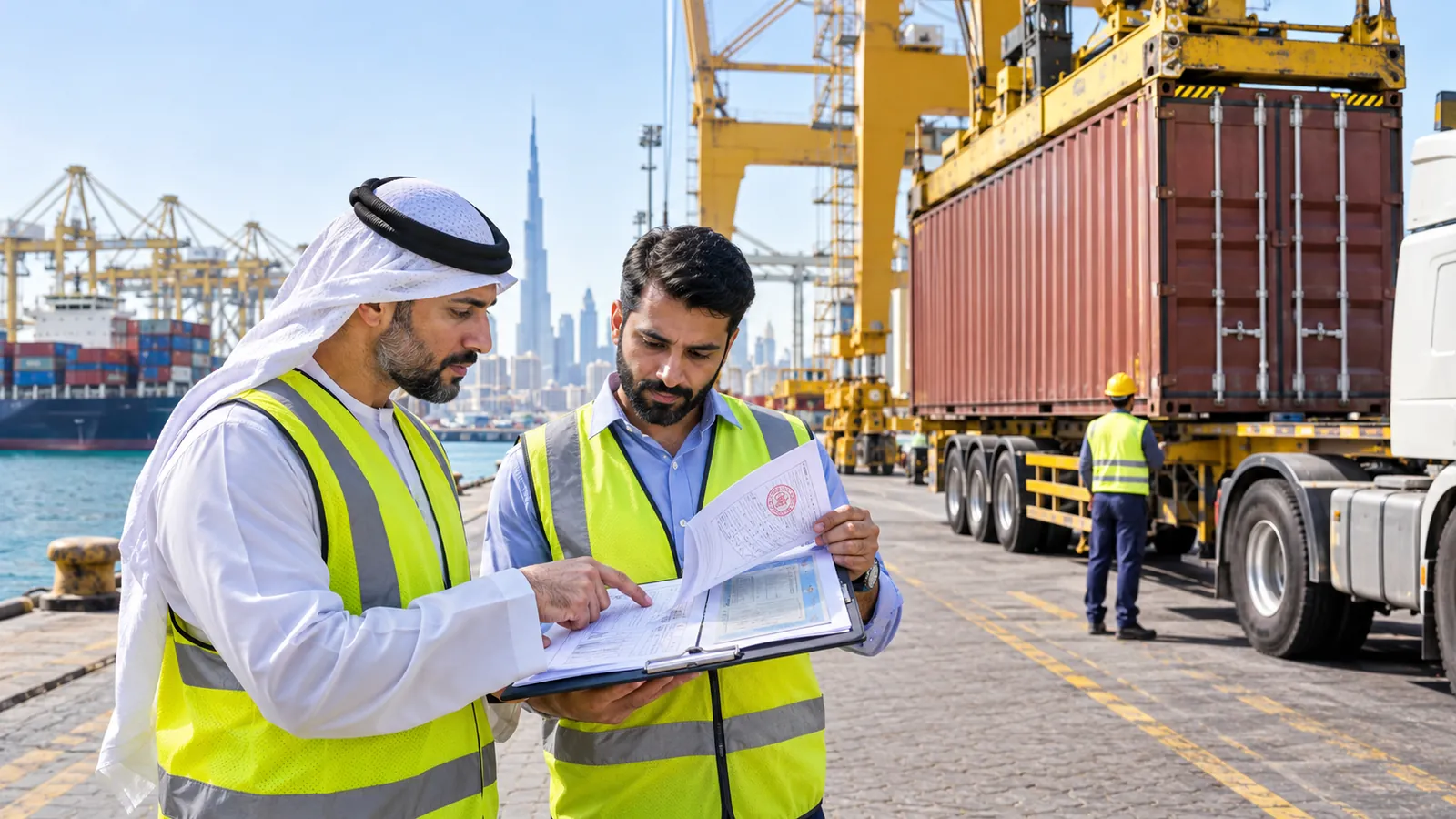
Most people think of customs as something that happens when goods arrive. But every shipment leaving the UAE also needs export clearance before it can be loaded on a vessel, aircraft or truck. If the export declaration is not approved in time, the cargo misses its cutoff, even if the container is already at the port. This guide explains how export clearance works in Dubai, what documents are needed and how to keep it from delaying your shipment.
What export clearance means
Export clearance is the approval from UAE customs that goods may leave the country. A declaration is filed electronically with the shipment details: exporter, consignee, description, HS codes, quantity, weight, value and destination. Once it is accepted, the cargo can be loaded. Our customs clearance team files these declarations for sea, air and road shipments, and the Jebel Ali customs clearance page covers the free zone and port side.
Types of export from the UAE
- Local export: goods made or already cleared in the UAE mainland, now leaving the country
- Re-export: goods that were imported and are being sent on to another country
- Free zone export: goods leaving directly from a free zone such as Jebel Ali Free Zone
- Transit: goods passing through the UAE without entering the local market
The type affects which declaration is used and which documents are checked. Transit cargo has its own process, explained in our Transit In / Transit Out guide.
Documents needed for export clearance
- Commercial invoice with the value, currency and Incoterm
- Packing list with packages, weights and dimensions
- HS codes for every product line
- Exporter's trade licence and customs code
- Booking details: vessel, flight or truck
- Permits for controlled goods where required
- Certificate of origin if the buyer or destination needs one
These are the same core documents used for imports; our customs documents checklist explains each one. Getting the HS code right matters on both ends, as the Jebel Ali import customs guide shows.
Certificates of origin
A certificate of origin states where the goods were made. Many buyers need it for their own import clearance, and some trade agreements use it to reduce duty at the destination. It is usually issued by a chamber of commerce or the relevant authority, based on the invoice and proof of origin. Ask your buyer early whether they need one, because it should match the invoice and the bill of lading exactly.
Restricted and controlled goods
Some goods need extra approval before export, for example certain chemicals, dual-use items, medicines, food products or used equipment. Dangerous goods also need correct classification and paperwork for the carrier; see our dangerous goods shipping guide. Cars need an export certificate, covered in the car export documents guide.
Timing against cutoffs
Every vessel and flight has a documentation cutoff as well as a cargo cutoff. The export declaration should be approved before the cargo gates in. For sea freight that means planning around the vessel cutoff, explained in our sea freight guide. For air freight, cutoffs are shorter, so documents must be ready before the cargo reaches the airline; see the air freight guide. Road shipments to Saudi Arabia also need export clearance at the UAE side of the border, covered in the UAE-Saudi border crossing guide.
Common reasons export clearance is held
- Invoice, packing list and booking show different weights or quantities
- Missing or wrong HS codes
- Vague goods descriptions like 'general cargo' or 'spare parts'
- Permit for controlled goods not issued yet
- Exporter's customs code not active
- Declaration filed after the cutoff
How export clearance fits the full shipment
Export clearance is one step in a chain: pickup, packing, clearance, loading and the bill of lading. When it is handled by the same team that books the freight, documents match and cutoffs are tracked together. That is the point of freight forwarding; our door-to-door forwarding guide shows how the steps connect. If several suppliers feed one shipment, the buyer's consolidation guide explains how documents are combined.
Export clearance checklist
- Confirm the export type: local, re-export, free zone or transit
- Check HS codes and goods descriptions
- Match invoice, packing list and booking
- Ask the buyer if a certificate of origin is needed
- Get permits for controlled goods early
- File the declaration before the document cutoff
Get your export cleared with NHK Logistics
Send your invoice, packing list and booking details through the quote form. NHK Logistics will check the documents, file the export declaration and coordinate with the carrier and the trucking so the cargo is cleared before cutoff. Rules and requirements change, so we confirm them for each shipment. For a full list of what to send us, see the freight quote checklist.
Need help with a shipment?
Send us the route and cargo details. We reply within 2 business hours.
Request a Quote